
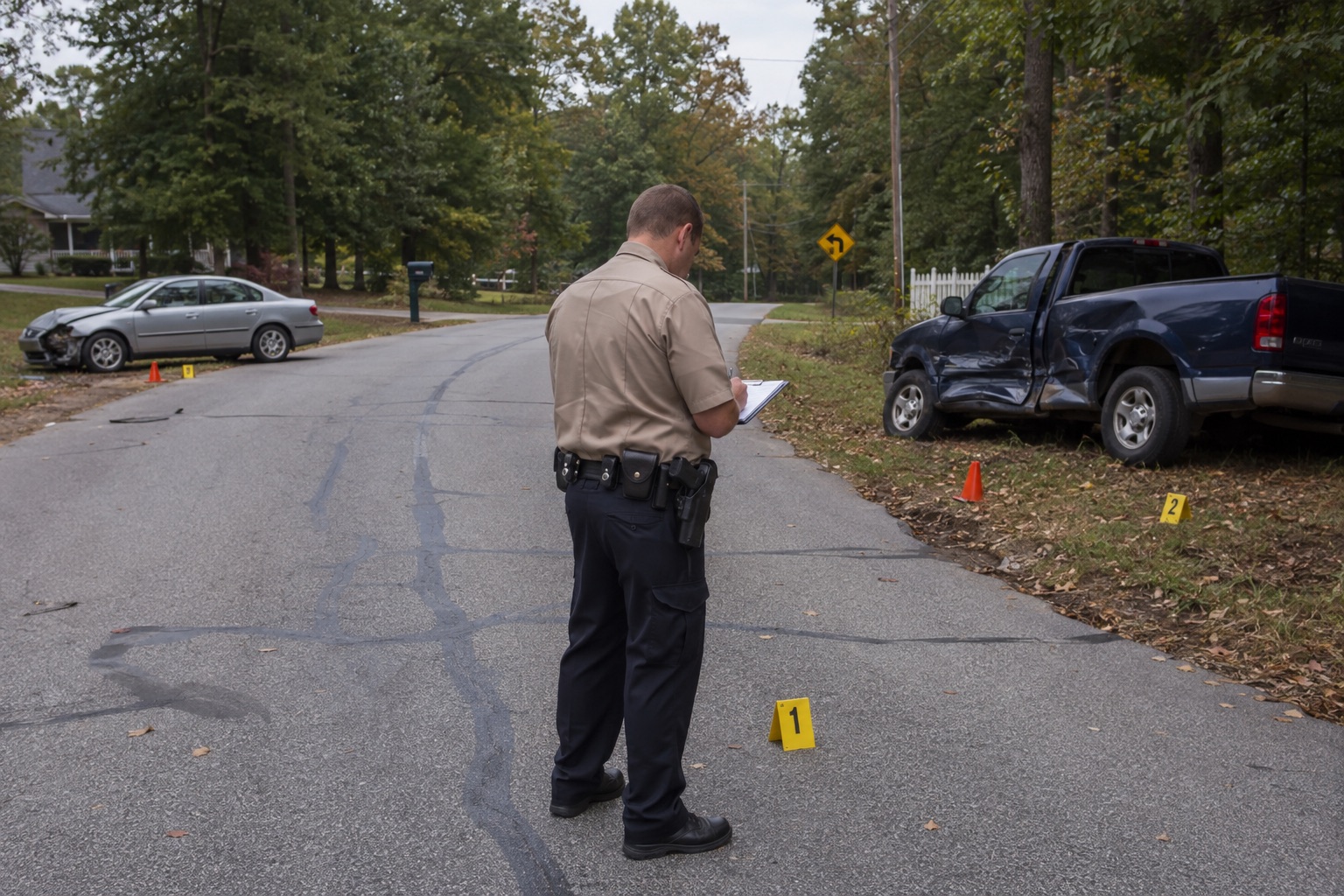
A county sheriff’s department may investigate collisions in unincorporated communities, contract cities, county facilities, or other areas within its jurisdiction. Request procedures differ from one county to another. The first step is to confirm which agency prepared the report, then follow that department’s official records instructions rather than relying on a generic commercial website.
Confirm the investigating sheriff’s department
Review the exchange-of-information card, incident number, citation, tow paperwork, photographs of patrol vehicles, or the officer’s business card. County boundaries and contract policing arrangements can be confusing, and a collision near a city line may have been handled by a city police department or highway patrol instead. If necessary, call the non-emergency line for the location where the crash occurred and provide the date, time, and cross streets.
Find the official records unit
Search the agency’s official government website for “records,” “traffic collision reports,” or “public records.” Some departments process collision reports through a central records and identification bureau; others use the traffic unit at the station that handled the crash. An agency may accept requests online, by mail, in person, or through a linked vendor. Start from the official agency page to confirm the correct method.
For example, the Los Angeles County Sheriff’s Department Records and Identification Bureau says involved parties may request traffic collision reports by calling its Public Services Section to submit a request and arrange an appointment, or by using the mail process. LASD advises that walk-in service may require an appointment. Procedures in another county can be different.
Information commonly requested
Prepare the incident or report number when known, collision date and approximate time, location, names of involved parties, vehicle description or plate, your contact information, and your relationship to the incident. The agency may require government-issued identification. An attorney, insurer, family member, or other representative may need written authorization or proof of legal authority.
Describe the record narrowly and accurately. Asking for the traffic collision report connected to a specific date, location, and involved person is usually clearer than making a broad request for “all records.” If you also need photographs, audio, body-camera video, diagrams, supplemental reports, or dispatch records, ask whether those items require separate requests.
Fees, timing, and release restrictions
Fees may be based on page count, certification, media reproduction, or vendor processing. Ask whether a regular or certified copy is appropriate for your purpose. Processing time depends on the investigation, supervisor approval, redactions, report age, and whether the request proves eligibility. Serious injury, fatality, arrest, or juvenile information may require additional review or a different process.
Traffic reports often contain addresses, birth dates, license information, insurance data, medical details, and witness contacts. Agencies can restrict access or redact protected information. Do not upload a complete report to a public website or send it through an unsecured channel.
California and Texas differences
In California, obtain the report from the sheriff’s department that investigated the incident and separately review whether a DMV SR-1 is required. The California DMV says qualifying collisions must be reported on the SR-1 even when a law-enforcement report exists.
In Texas, a sheriff’s deputy may prepare the Texas Peace Officer’s Crash Report, form CR-3. TxDOT is the state custodian for qualifying crash records and provides an official online purchase system for eligible requesters. A county agency may also provide local incident-related records, so identify exactly which document you need.
Review and preserve the report
Check names, vehicles, insurance, passengers, witnesses, location, diagram, narrative, citations, and attachments. Compare the report with your own photographs and notes. For a factual error, contact the issuing department and ask about its amendment or supplemental-statement procedure. Keep the original unchanged and preserve proof of anything submitted.
Continue with our local police report, online request, and collision report overview guides.
General educational information only. Eligibility, fees, office hours, and release procedures change; verify current instructions with the investigating sheriff’s department.